2 days
How a check clears: what happens between deposit and final payment
The money may show in your account long before the bank that holds the check's account has paid it. Here is the route a check takes, who can send it back, and what that means for you.
By HonestRudder Editorial Team Updated 5 min read
- Bank that pays the check
- The writer's bank
- Normal debit time
- Next business day
- Return deadline
- 2 p.m., 2nd business day
- Money you can see
- Not proof it is good
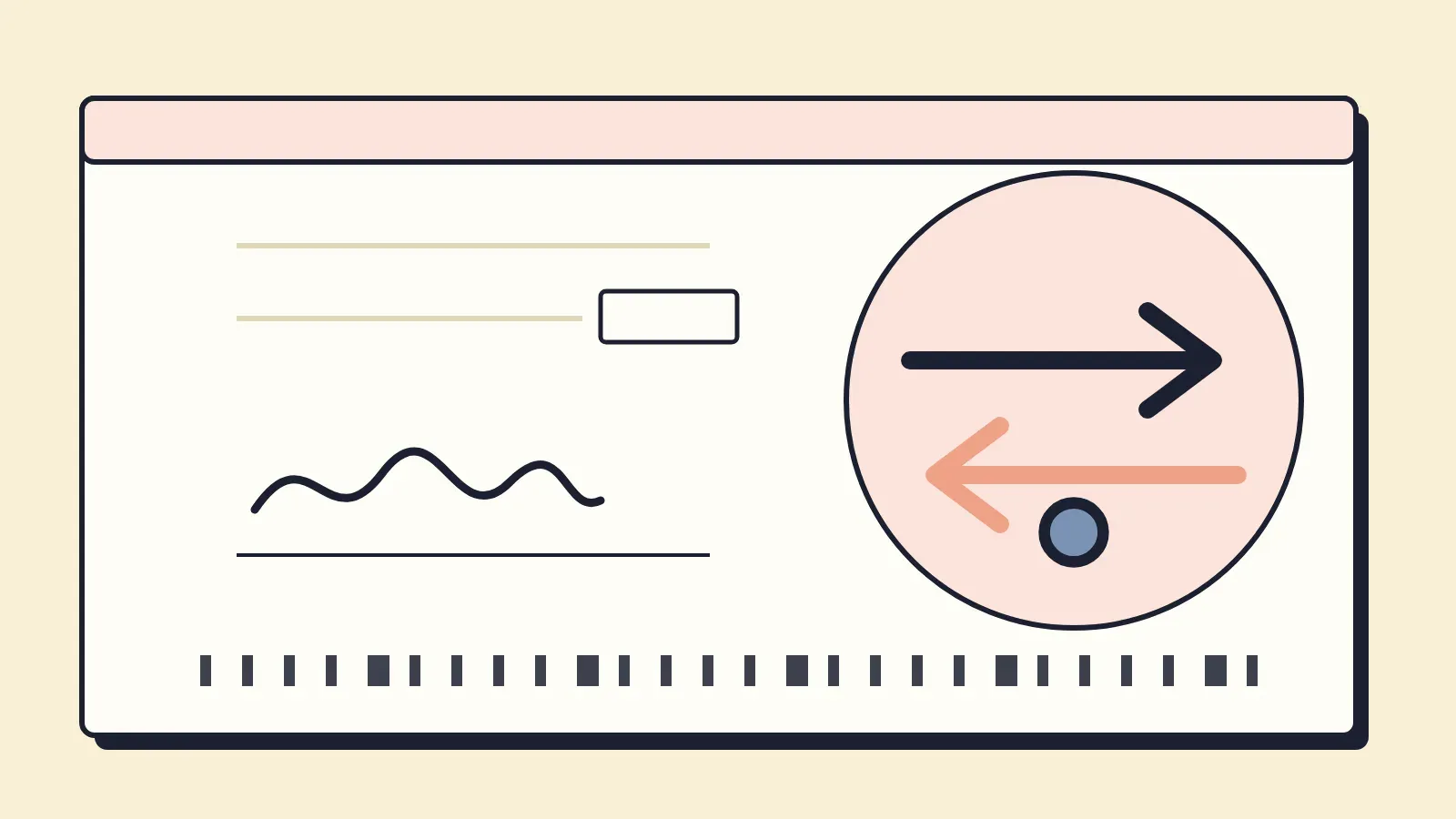
In short
When you deposit a check, your bank sends it to the bank where the writer's account is held, called the paying bank. The Federal Reserve says deposited checks are almost always delivered to the paying bank overnight and debited the next business day. The paying bank can still return a check unpaid, and under Regulation CC it must do so by 2 p.m. on the second business day after the check reaches it. Your bank may show the money as available sooner than that, so available is not the same as cleared.
The path a check takes
A check is an instruction to the writer's bank: pay this amount to this person. When you deposit one, your bank becomes the depositary bank. It does not own the money yet. It sends the check, or an image of it, toward the bank the check is drawn on, which is the paying bank. The paying bank looks at the writer's account and either pays the check or sends it back.
| Step | Who acts | What happens |
|---|---|---|
| 1. Deposit | You and your bank | You hand over the check, deposit it by app or ATM, or mail it in. Your bank records the deposit. |
| 2. Presentment | Your bank and the paying bank | The check or its image is sent to the paying bank, often through the Federal Reserve or another clearing channel. |
| 3. Decision | The paying bank | The bank checks the writer's account and decides to pay the check or return it unpaid. |
| 4. Settlement | The two banks | If the check is paid, the paying bank's payment reaches your bank, and the writer's account is debited. |
| 5. Return, if any | The paying bank | A check that is not paid travels back to your bank, which can then reverse the credit it gave you. |
The Federal Reserve's own guidance on the Check 21 law notes that processing was already fast before 2004: deposited checks are almost always delivered overnight to the paying bank and debited the next business day. The same route runs in the other direction for checks you write. The CFPB notes that the money leaves your account when the person you paid deposits or cashes the check, which can be days after you mailed it. Nothing in the Federal Reserve's guidance changes how long your bank can hold the funds. Those limits are set separately, in check holds and funds availability.
Paper, images and substitute checks
Many checks never travel as paper. The Check Clearing for the 21st Century Act, known as Check 21, took effect on October 28, 2004. It lets a bank capture an image of the front and back of a check and send that image instead. When a bank still needs paper, it prints a substitute check, which the Federal Reserve describes as the legal equivalent of the original check. The law does not require banks to accept checks in electronic form.
Check 21 also gave you a narrow protection. If a substitute check was wrongly charged to your account and you lost money, you can ask your bank for a refund. Contact the bank within 40 days after it mailed or delivered the statement. If the bank cannot decide within 10 business days, it must provisionally refund up to the lesser of the substitute check amount or $2,500 plus interest, and it must refund any remaining loss by the 45th calendar day unless it finds the claim invalid. The Federal Reserve explains the rules in its Check 21 FAQ.
Available is not the same as cleared
Federal law requires banks to make deposited funds available within set times, and those times are often shorter than the time it takes the paying bank to finish. So you can see the money and spend it while the check is still unpaid. The Federal Trade Commission puts it plainly: even if you see the funds in your account, that does not mean it is a good check.
If the check turns out to be fake or is returned, the bank takes the money back. The FTC says it can take weeks for a bank to figure out that a check is a fake, and that you are then stuck paying the money back to the bank. That is the pattern behind check scams that ask you to send part of the money onward. See fake check and overpayment scams.
Why a check comes back and how fast
The paying bank may decline a check, most simply because the writer's account cannot cover it. A bank that does this is declining the payment, and it may charge the writer a non-sufficient funds fee. The difference between that fee and an overdraft fee is explained in overdraft and NSF fees.
Regulation CC sets the clock for the return. If the paying bank decides not to pay, it must send the check back so that it would normally be received by your bank by 2 p.m., your bank's local time, on the second business day after the check was presented. For a check of $5,000 or more, the paying bank must give notice of nonpayment by the same deadline, and a phone call is among the ways it may do so. The rule is 12 CFR 229.31.
Those deadlines are for banks, not for you. A returned check can still reach you days after the deposit looked final, and a bank may debit the amount back from your balance when it does.
What to do when you deposit a check
- Know who wrote it. A check from an employer, a government agency or someone you deal with face to face carries less risk than one from a stranger.
- Keep the paper. If you deposited by phone, write the deposit date on the check and keep it until the money has cleared. Mobile check deposit covers this in detail.
- Watch your balance. Do not spend money you cannot afford to lose until you are sure the check is good. Your bank's current available balance may include money that is not yet final.
- Use the clock. The funds availability tool works out when a deposit should be available under the federal schedule.
If your bank holds a deposit longer than the rules allow, or reverses a deposit without explaining, ask the bank first. If that does not settle it, you can complain to the Consumer Financial Protection Bureau at consumerfinance.gov/complaint.
Common questions
How long does it take for a check to clear?
The Federal Reserve says deposited checks are almost always delivered overnight to the paying bank and debited the next business day. Your bank may hold the funds for longer or shorter, and a returned check can still arrive after that.
If the money is in my account, is the check good?
Not necessarily. Banks must make funds available within set times, but the FTC warns that seeing the funds does not mean the check is good. The bank can take the money back if the check is returned.
How long does the paying bank have to return a check?
Under 12 CFR 229.31, a returned check should normally reach the depositary bank by 2 p.m. on the second business day after presentment. Notice of nonpayment on checks of $5,000 or more follows the same deadline.
What is a substitute check?
A paper copy made from an image of the original check. The Federal Reserve says it is the legal equivalent of the original if it meets the requirements, including the required statement on its face.
Sources
- Federal Reserve Board, Frequently asked questions about Check 21
- eCFR, 12 CFR 229.31, Returned checks, notices in lieu of return, and recredit
- FTC, How to spot, avoid, and report fake check scams
- CFPB, Ways to pay your bills (newcomer's guide)
Facts on this page were checked against these sources on November 21, 2026. The Federal Reserve's Check 21 guidance dates from the years after the law took effect, so ask your bank how it handles images and returns today.
Related reading
-
Payments guide
Check holds and funds availability
The Regulation CC schedule, the reasons for a longer hold and the written notice a bank must give.
-
Payments guide
Mobile check deposit
How a photo deposit works, why to keep the paper check, and why a visible balance is not proof.
-
Rights guide
Fake check and overpayment scams
Why a deposit can show as available and still be fake, and why the bank comes to you for repayment.